

How to Write Effective Dialogue
Even if you suck at it. Breaking down dialogue from In Bruges.

Dialogue’s tough. I suck at dialogue. What is good dialogue anyway?
Ever had these thoughts? I did. I still do sometimes. And dialogue definitely requires the most effort from me when it comes to writing. So much so, I try to write scenes without it at every opportunity. The good news — physiology is on my side. Since we get like 80% of info visually, if I can find a visual solution to a scene, it actually becomes more effective.
But auditory experience still accounts for 20%. Can we discard 20%? Well, if we’re ok to suck at writing — I suppose so. But that’s not why we’re here.
So let’s take a little trip to In Bruges and try to figure out what makes dialogue effective.
But first, you gotta have tickets to go to Belgium. And your ticket is to share this article.
Hold on. You’re not subscribed? Get outta hereButton to fix this atrocity below:
The Scene

I specifically picked a scene that fully relies on dialogue (and performance). So we’re not distracted by blocking, interesting visuals, and all that fluff.
Just two people sitting on a bench — two killers, Ken and Ray, laying low in Bruges after a hit gone wrong. Ray accidentally killed a child. And that’s all you need to know, really.
KEN
I don’t know, Ray. I don’t know what I believe. The things you’re taught as a child, they never really leave you, do they? So, like, I believe in trying to lead a good life. Like, if there’s an old lady carrying her shopping home, I don’t try and help her carry her shopping, I don’t go that far, but I’ll certainly hold the door open for her and that, and let her go out before me.
RAY
Yeah. And anyway, if you tried to help her carry her shopping, she’d probably think you were just trying to nick her shopping.
KEN
Exactly.
RAY
This is the world we live in today.
KEN
At the same time as trying to lead a good life, I have to reconcile myself with the fact that, yes, I have killed people. Not many people. Most of them were not very nice people. Apart from one person.
RAY
Who’s that?
KEN
This fellow, Danny Aliband’s brother. He was just trying to protect his brother. Like you or I would. He was just a lollipop man. He came at me with a bottle. What are you gonna do? I shot him down.
RAY
Hmm. In my book, though, sorry, someone comes at you with a bottle, that is a deadly weapon, he’s gotta take the consequences.
KEN
I know that in my heart. I also know that he was just trying to protect his brother, you know?
RAY
I know. But a bottle, that can kill you. It’s a case of it’s you or him. If he’d come at you with his bare hands, that’d be different. That wouldn’t have been fair.
KEN
Well, technically, your bare hands can kill somebody, too. They can be deadly weapons too. I mean, what if he knew karate, say?
RAY
You said he was a lollipop man.
KEN
He was a lollipop man.
RAY
What’s a lollipop man doing knowing fucking karate?
KEN
I’m just saying.
RAY
How old was he?
KEN
About fifty—
RAY
What’s a 50-year-old lollipop man doing knowing fucking karate? What was he, a Chinese lollipop man? Jesus, Ken, I’m trying to talk about…
KEN
(after a beat)
I know what you’re trying to talk about.
RAY
I killed a little boy. You keep bringing up fucking lollipop men!
KEN
You didn’t mean to kill a little boy.
RAY
I know I didn’t mean to. But because of the choices I made and the course that I put into action, the little boy isn’t here anymore. And he’ll never be here again.
(beat)
I mean here in the world, not here in Belgium. Well, he’ll never be here in Belgium, either, will he? I mean, he might have wanted to come here when he got older. I don’t know why. And that’s all because of me. He’s dead because of me. And I’m trying to… I’m trying to get me head around it, but I can’t. I will always have killed that little boy. That ain’t ever going away. Ever. Unless… Maybe I go away.
KEN
(after a beat)
Don’t even think like that.
Why It Works Psychologically
1. Why opinions engage us, and facts don’t?
Worldview Window
Psychologically, stories and opinions spark more emotional and cognitive involvement than factual bullet points. Here, Ken’s reminiscence about the lollipop man prompts us to visualize that off-screen event and empathize with his remorse. In essence, the dialogue’s personal tone triggers our brain’s social circuits – we process Ken’s confession almost like a friend confiding in us. People naturally identify closely with personal stories, imagining how we would feel or act in similar circumstances.
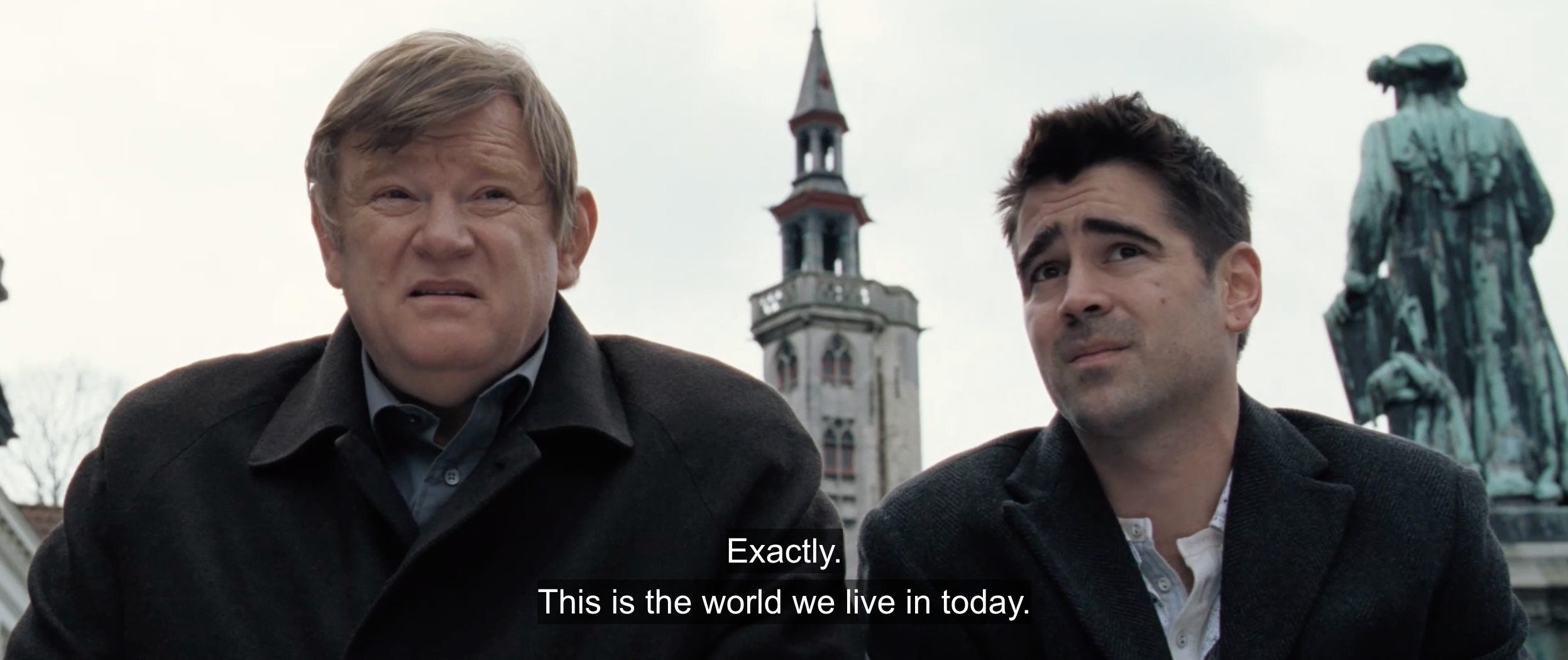
By being broad enough to tap universal feelings of guilt and atonement, the characters “invite us to fill in the blanks with our own emotional history,” making the scene feel personally resonant. In short, we’d much rather hear characters speak from the heart – recalling what haunts them and how they see the world – because it engages our empathy and imagination in a way plain facts never could.
Psychology Cheat Sheet:
What it is: Worldview Window — characters speak from personal views and past experiences rather than explaining current events.
What it does: Reveals authentic backstory and beliefs, inviting the audience into the characters’ inner world instead of boring them with facts.
Why it works (science): Personal stories engage more of our brain (emotion, imagination) than factual exposition. We empathize and even project ourselves into the narrative, since storytelling triggers identification and richer processing than dry info.
Effect on viewers: We feel invested in the characters. The dialogue strikes an emotional chord and feels relatable, so we care more about what happens to Ken and Ray.
2. Why do we feel like there’s something else going on underneath the lollipop man story?
Theory of Mind (Goal-Driven Subtext)
The dialogue is filled with subtext: Ken’s gentle recollection and Ray’s probing questions are really about Ray seeking permission to forgive himself. We, as the audience, can sense this clash of goals even before Ray’s emotions explode. The result? We’re glued to every line, trying to read between them to figure out what each man really means. It’s far more emotionally arresting than if Ray had simply said, “I feel guilty about killing that kid” from the start. Instead, we lean in, decoding the subtext and anticipating the moment the truth will finally surface.
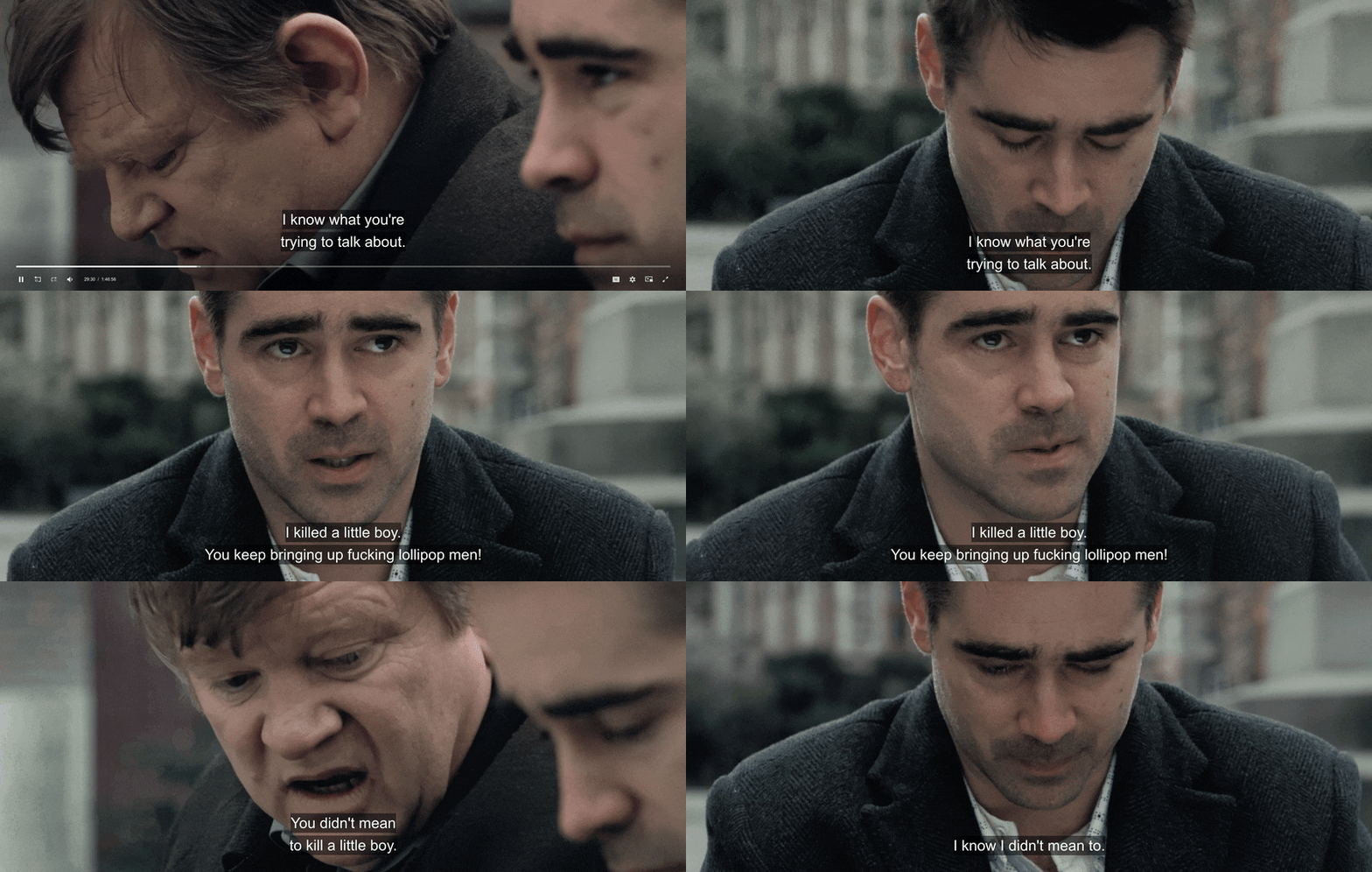
Our brains love this kind of mental guessing game. Humans are wired to be intuitive social detectives – “naturally inferring stories from subtle cues” and constantly reading between the lines to understand others. In psychological terms, the scene engages our theory of mind: we’re exercising the neural circuits for inferring others’ thoughts and feelings, which pulls us in deeply. We become active participants in the scene, not passive observers, because we’re busy assembling clues (Ken’s pauses, Ray’s evasive agreement) to grasp the full picture. There’s even a hit of reward in doing so. Studies show we get a dopamine kick from solving social puzzles. Indeed, when we successfully connect the dots (“Oh, Ken is indirectly talking about Ray’s incident to make him feel better”), our brain’s reward system gives a little “aha” approval, making it gratifying to figure out the subtext. Crucially, all this subtextual tension means that when the dam finally breaks – when Ray’s guilt erupts – the emotional payoff is much stronger.
We’ve felt the pressure under the dialogue and earned that release. The big emotional reveal “hits harder and lingers longer because we unearthed it” ourselves, rather than being told outright. In short, goal-driven subtext hooks us with curiosity and tension, engages our mind-reading instincts, and delivers a more powerful catharsis when the unspoken finally comes out.
Psychology Cheat Sheet:
What it is: Theory of Mind (Goal-Driven Subtext). A conversation where characters have hidden, conflicting goals (one seeking relief, the other offering absolution) – most meaning lives between the lines.
What it does: Creates an undercurrent of tension and mystery; the audience must infer the unspoken truths and anticipate a resolution. Every line has double meaning, keeping us mentally active and emotionally keyed up.
Why it works (science): Subtext engages theory-of-mind networks, making us feel like sleuths – an enjoyable, rewarding process. When we finally grasp the subtext or see it surface, it triggers a satisfying aha reward in the brain. Plus, holding back information sustains suspense, so arousal stays high.
Effect on viewers: Intense engagement – we’re not just watching the drama, we’re solving it. We feel clever for reading the subtext, more connected to the characters’ emotions, and the eventual emotional release (when the truth spills out) hits us harder and lingers longer.
3. Why does this serious scene make us laugh?
Tension — Release
McDonagh masterfully offsets heavy content with absurd humor, as in Ray’s outburst: “What’s a fifty-year-old lollipop man doing knowing fucking karate?!”* This running gag about the karate lollipop man injects a burst of laughter right when things are getting bleak. Why pepper a grieving conversation with a silly, repetitive joke?
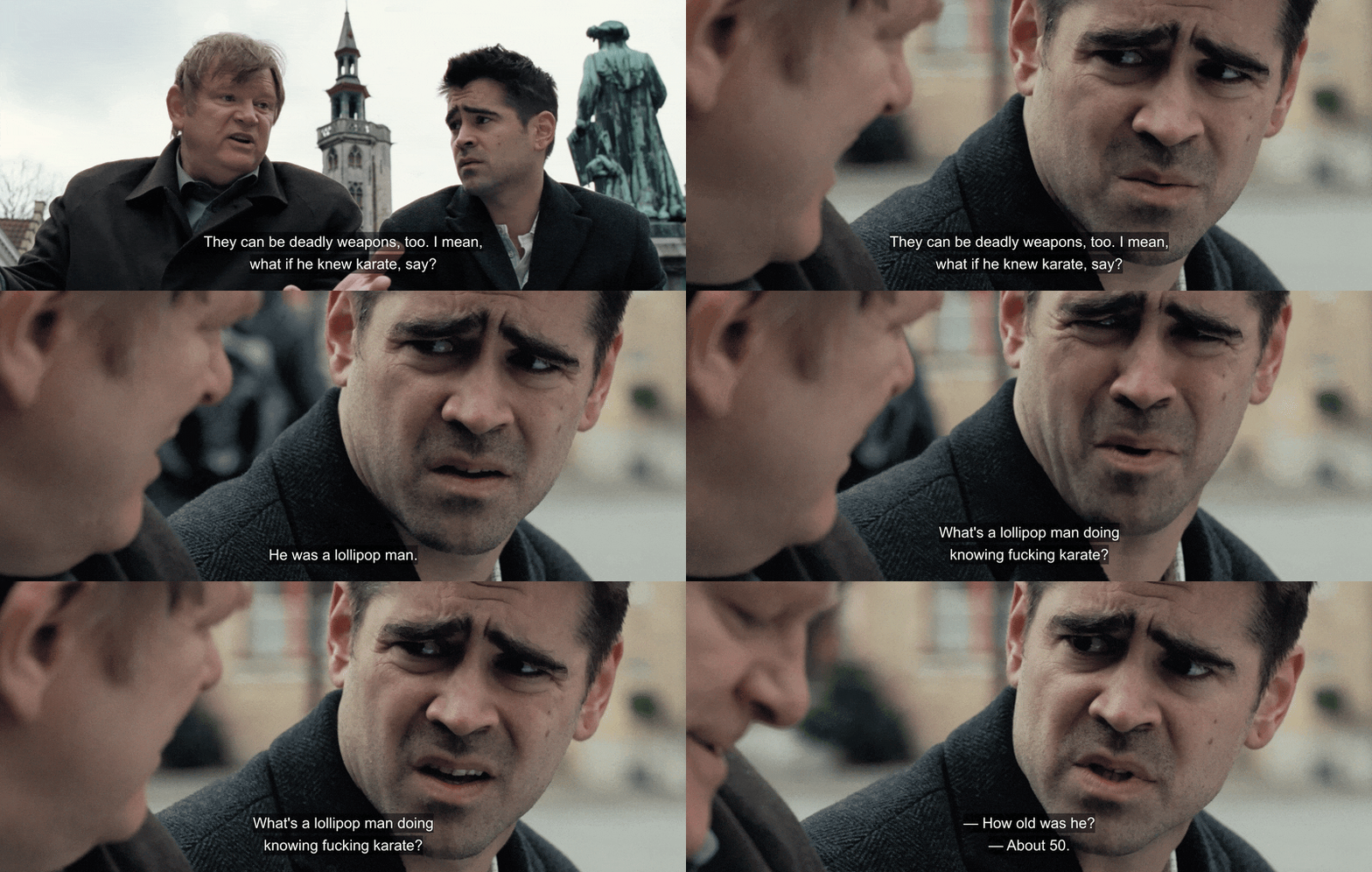
Humor and tragedy have a symbiotic relationship in storytelling: a well-timed joke releases tension and spikes our brain’s reward chemistry, which in turn makes us more receptive to the next emotional punch. In fact, an ability to laugh during “rough moments” actively reduces stress and creates positive feelings, essentially clearing space for deeper emotions to land afterward. In the bench scene, every quip about the karate lollipop man acts like a pressure valve – letting the audience exhale some anxiety through laughter. Physiologically, it likely quells our cortisol (stress hormone) and even triggers endorphins, relaxing us momentarily before the story plunges back into darkness. This means when the sorrow hits, it feels sharper.
Additionally, the humor here works through clever repetition. Ray harps on the ridiculous image of an old crossing guard doing karate, repeating it until it’s deliriously funny. Psychologists note that the “Rule of Threes” makes repetition comedic – jokes often peak when a pattern is set up and then exaggerated or broken on the third beat. In other words, each callback about the lollipop man escalates the absurdity, prompting bigger laughs.
Our brains also love the surprise inherent in such tonal shifts. A sudden swerve from somber guilt to goofy humor is an unexpected violation of tone that yanks our attention and even gives a mini dopamine jolt (we get a tiny rush from the novelty).
This modulation helps us emotionally track the scene: the humor makes the darkness bearable, and the darkness gives the humor a bittersweet edge. By the time Ray finally breaks down, we’ve been on a wild ride of feelings, which makes that cathartic moment hit with maximum force. The result is a dialogue scene that leaves us both chuckling and deeply moved.
Psychology Cheat Sheet:
What it is: Tension — Release. A deliberate mix of light and dark tones builds to a big cathartic payoff.
What it does: The rhythmic shifts in pacing (jokes, rapid-fire banter, then slow, heavy confession) keep us alert and emotionally flexible.
Why it works (science): Laughter releases stress and boosts mood, resetting our arousal so heavier emotions can hit fresh. The brain also loves surprise – an upbeat joke amid darkness is a rewarding jolt of novelty. By the “rule of three,” strategic repetition of a funny element (e.g. the karate lollipop man) heightens our amusement each time, giving little dopamine rewards that keep us hooked.
Effect on viewers: The comedy makes us let our guard down and even bond with the characters through shared laughter, so when the gut-punch of emotion comes, it feels sharper and more genuine.
Can we talk about writing dialogue now?
1. Want the audience to learn more about the characters — and not be boring?
Have your characters speak in opinions and tell each other stories.
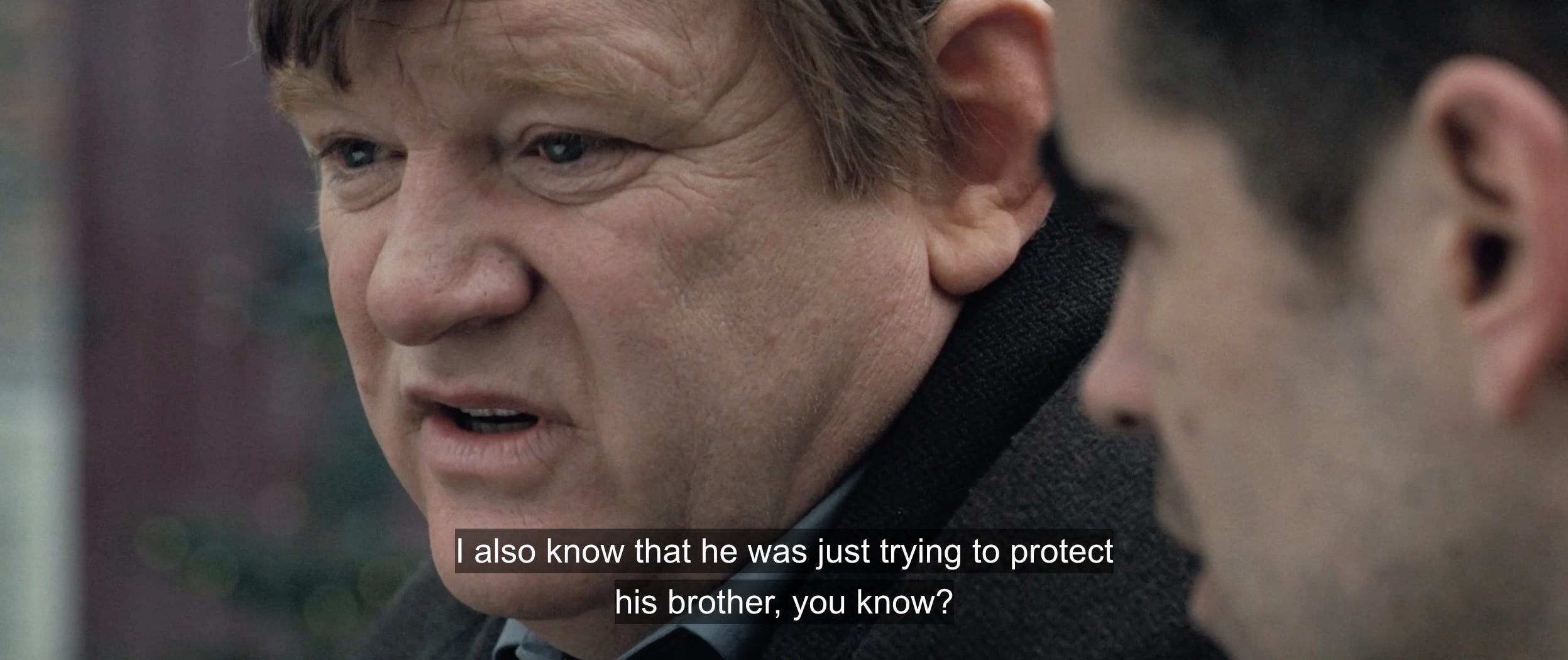
Let the dialogue expand on the past of your characters, involve personal anecdotes and/or shared history. The key is not to repeat what we have already seen on-screen, but to expand the world through characters’ experiences.
It’s ok, the audience won’t have all the context of an off-screen story your character shares as long as you make that story very specific (like Ken remembering his victim by name) and serve as a tactic (how is this story/anecdote bringing the character closer to their goal in the scene).
2. Want the audience to pay attention?
Make them solve the subtext.
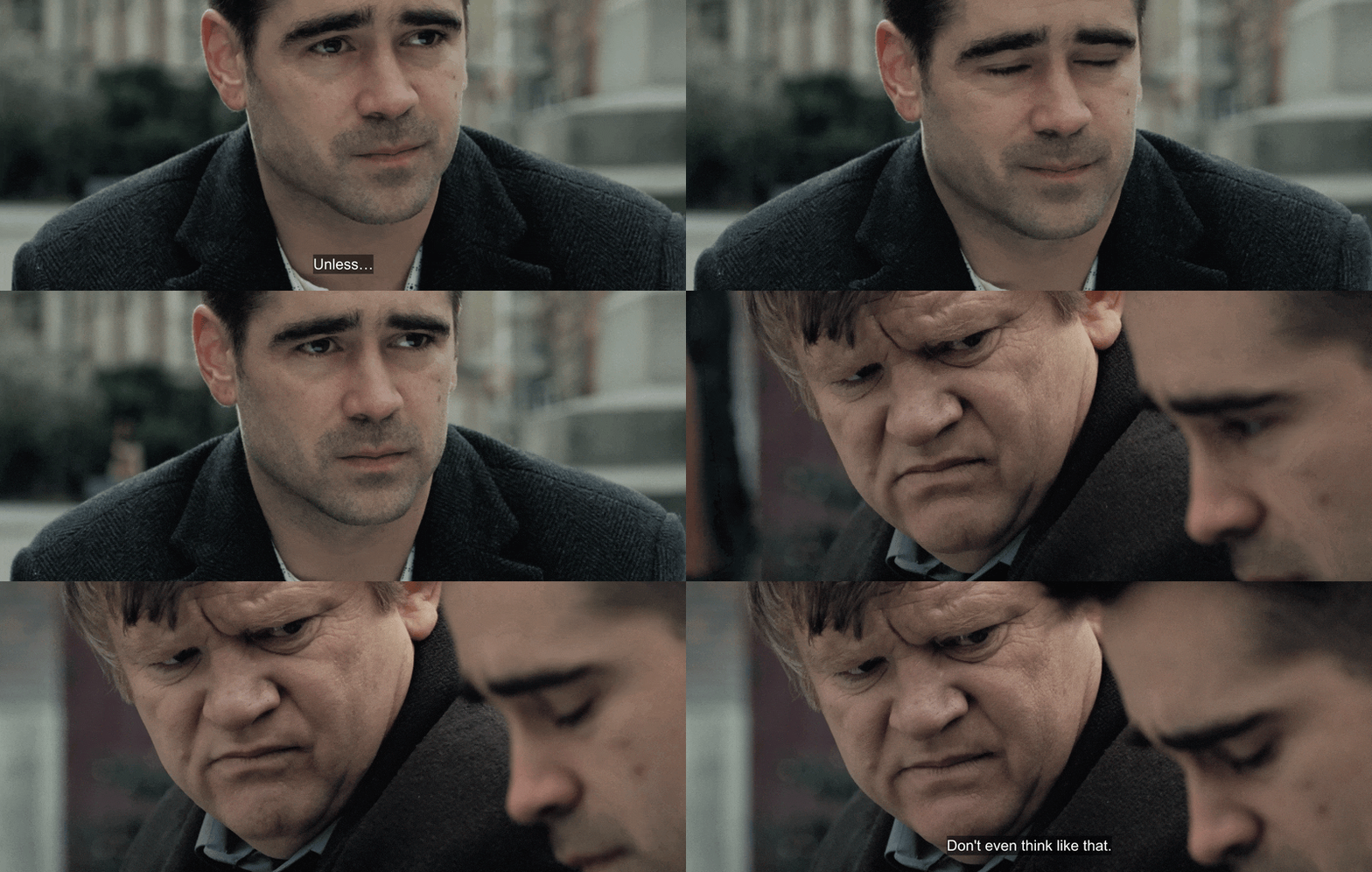
First, make sure you have figured out what is really going on in the scene. What are the characters really talking about and why? If it helps, write the scene out in a completely straightforward manner, like:
KEN
I’ve killed innocent people before, too. It still haunts me, but that’s something you can live with.
RAY
I don’t think I can.
Once you’ve got the meaning down, think of how you can hide those real intentions, creating subtext that the audience will be trying to solve later. The toolbox includes character opinions, past-time stories, physical actions, blocking etc.
But don’t forget to give the clues. Here, Ray’s spike of interest when Ken mentions that there was one “nice” (as in innocent) person he killed is the first clue. Ray’s disappointment when it turned out the person was actually a threat to Ken is second. And the third clue happens, when Ken tries too hard to comfort Ray, coming up with the karate nonsense.
3. How to create an emotional ride for the audience when everyone’s sitting on a bench?
Change rhythm, shift tone, use humor.
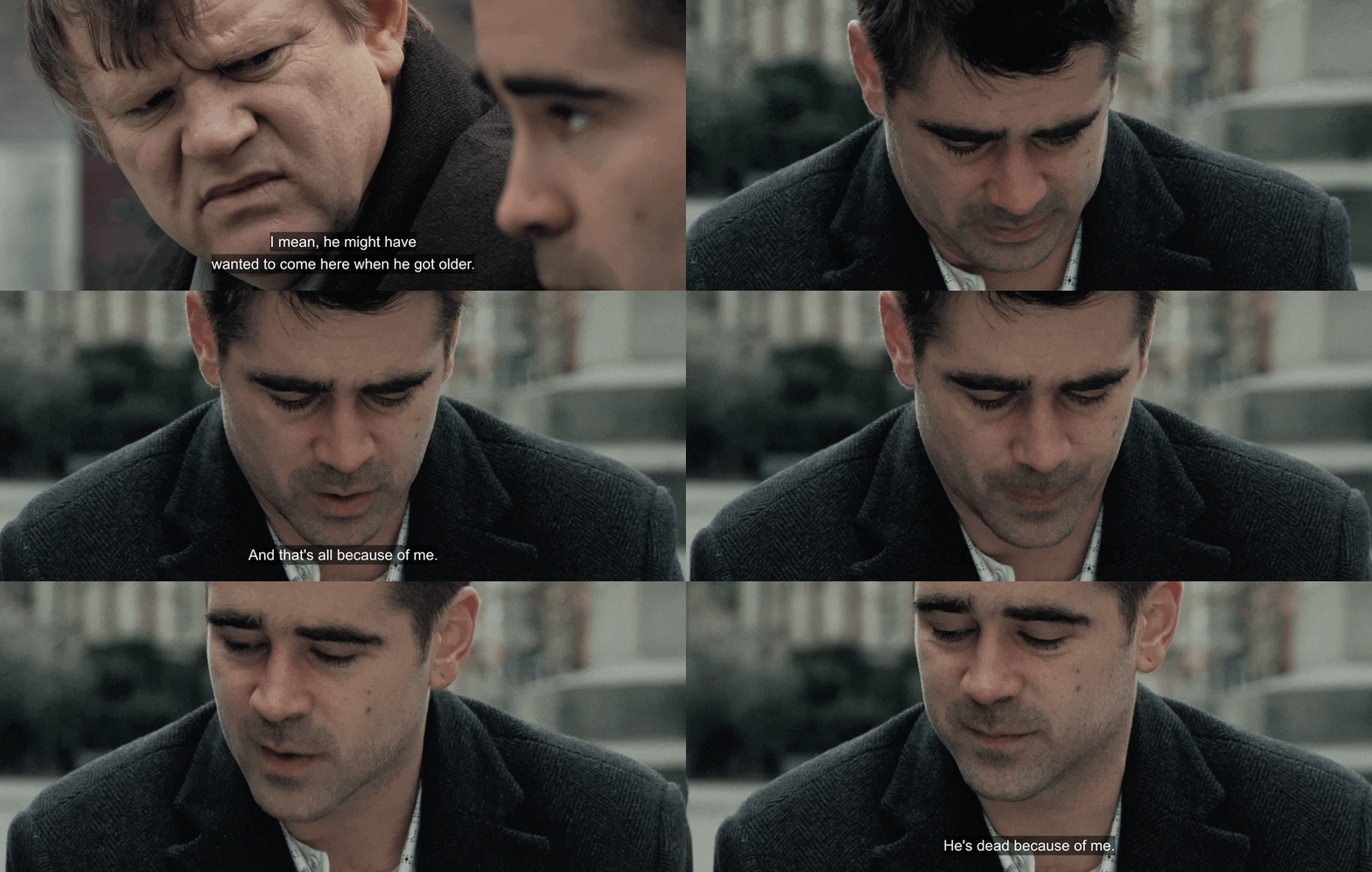
Goals, tactics, obstacles, switches = conflict. That’s the only real recipe for keeping the audience engaged. Dialogue or not.
Even if you completely let go of action and put your characters on a bench, make sure to give them clear goals they’ll try to achieve with dialogue. Opposing goals always work great. And don’t forget to use switches (new information) that can turn the scene around by acting as a trigger — in our case, Ray confronting Ken’s “he could’ve known karate” bit that serves as an immediate escalation.
Don’t know if this helps you write better dialogue. But at least it should help clarify how dialogue works, and that’s already a plus.
This breakdown definitely helped me.
Otherwise, there’s nothing better than listening to others speak, reading modern fiction, and doing research on the type of characters you’re working with. All classic stuff.
Or maybe you’ll always suck at dialogue. And it’s ok. To suck a bit in something in your professional sphere is healthy. The trick is not to suck balls.
“I find dialogue a bore, for the most part. I think that if you look back on any film you’ve seen, you don’t remember lines of dialogue, you remember pictures.”
— David Lean

The man knew his stuff.
Until next time.
I've just subscribed I'm gonna go mine that book of yours thanks 🤝🤝