

How to Write (Awesome) Voiceover
Diving deep into Fight Club. The Fight Club.

The first rule of Fight Club is: you do not talk about Fight Club. The second rule is: you don’t talk about Fight Club.
But there’s a third rule: you break down Fight Club to learn how to make a masterpiece. But in our particular : how to write voiceover and why it works when done right.
Scene
The Narrator (a.k.a the nameless protagonist, a.k.a. Edward Norton) has just landed, and is on the way home when he’s greeted by fire trucks and sirens.
His apartment exploded.
And while the Narrator tries to wrap his head around what’s happened, we hear the voiceover:
Home was a condo on the fifteenth floor of a filing cabinet for widows and young professionals. The walls were solid concrete. A foot of concrete is important when your next-door neighbor lets her hearing aid go and has to watch game shows at full volume... Or when a volcanic blast of burning gas and debris that used to be your furniture and personal effects blows out your floor-to-ceiling windows and sails flaming into the night.
As shock settles on his face, the voiceover continues:
I suppose these things happen.
The Narrator passes by the charred remains of his IKEA furniture and gets sent away by the doorman, inquiring if there’s anyone he could call.
Walking out, he stares at the carcass of his fridge — ketchup and mustard splashed everywhere.
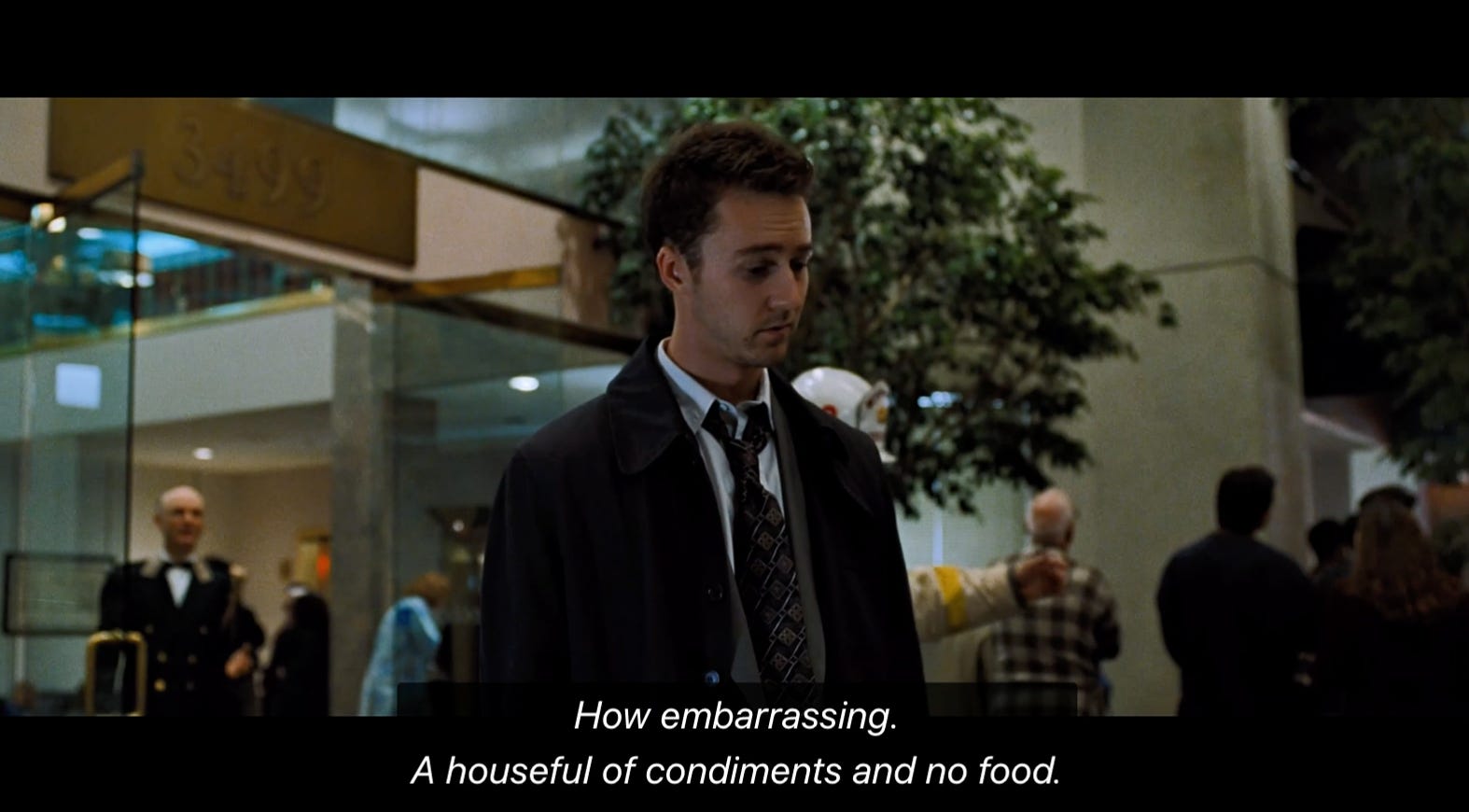
How embarrassing. A house full of condiments and no food.
Among the wreckage, the Narrator picks up the surviving piece of paper with Marla’s number on it, while the voiceover explains how the apartment might have blown up.
Pretty much every scene of Fight Club is textbook writing, but since we’re talking voiceover today, let’s pause here… and subscribe.
Why It Works Psychologically
Privileged Access + Cognitive Tension
Voiceover bonds us to the Narrator through Privileged Access: direct access to his inner commentary. Psychologically, that functions like controlled self-disclosure. Research in social cognition shows that when someone shares private thoughts, we instinctively read it as intimacy — even if those thoughts are cynical or detached. We’re not just watching Edward Norton stand in front of the smoking wreckage — we’re inside his head while it happens.
But the real magic is the contrast.
I suppose these things happen.
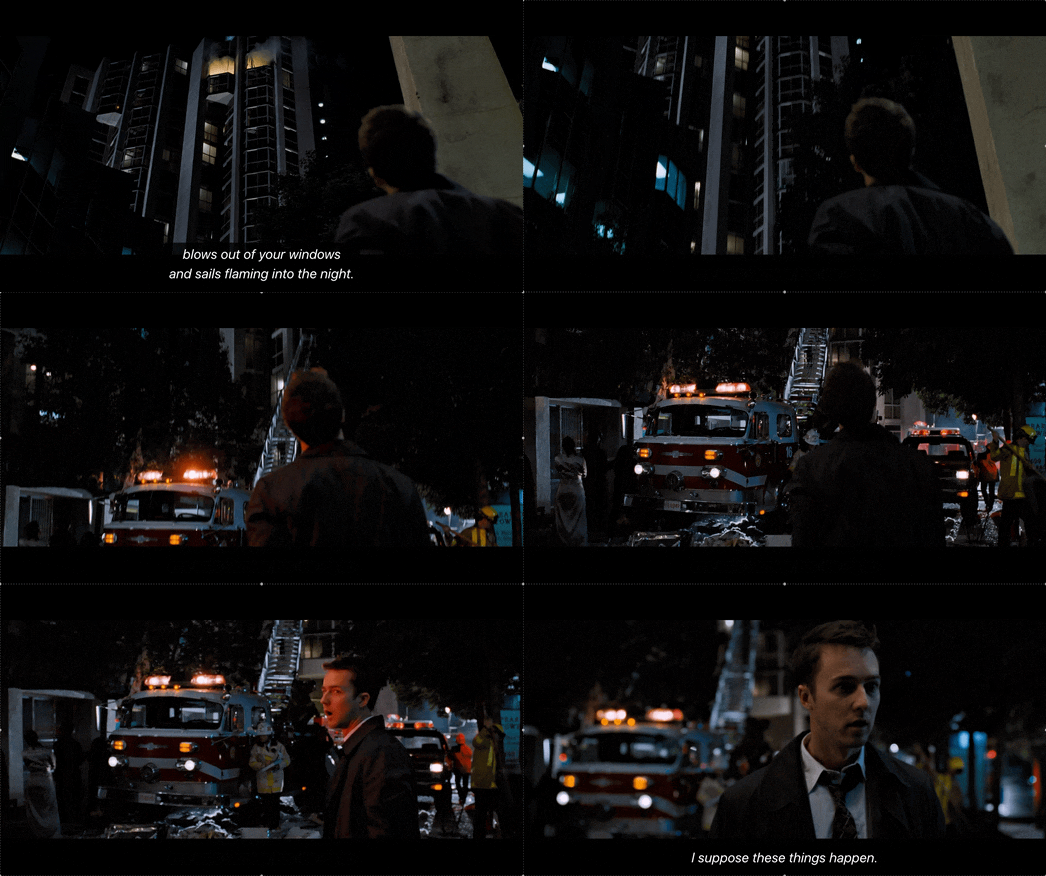
Visually, we see a life destroyed. Auditorily, we hear a shrug. This creates Prediction Error — a gap between the expected emotional response (panic) and the actual one (apathy). The brain is wired to resolve these gaps. It immediately starts to solve the discrepancy: Is he numb? In denial? Dissociated? That micro-puzzle keeps us cognitively active. Contrast turns passive viewing into active interpretation.
Now compare that to a boring voiceover — the kind that simply says what we already see.
A house full of condiments and no food.
Redundant narration adds zero new information. From a cognitive standpoint, that’s dead air. Our brains reward novelty and meaning, not repetition. If the image already tells us something, and the voiceover merely duplicates it, there’s no puzzle, no new context, no emotional layer. Processing becomes fluent but unrewarding. Engagement drops.
But hold on. That’s not the line we have in the movie. That’s right, because Fincher knows how to keep you engaged. That’s why he adds Emotional Framing to the beginning of the line.
How embarrassing. A house full of condiments and no food.
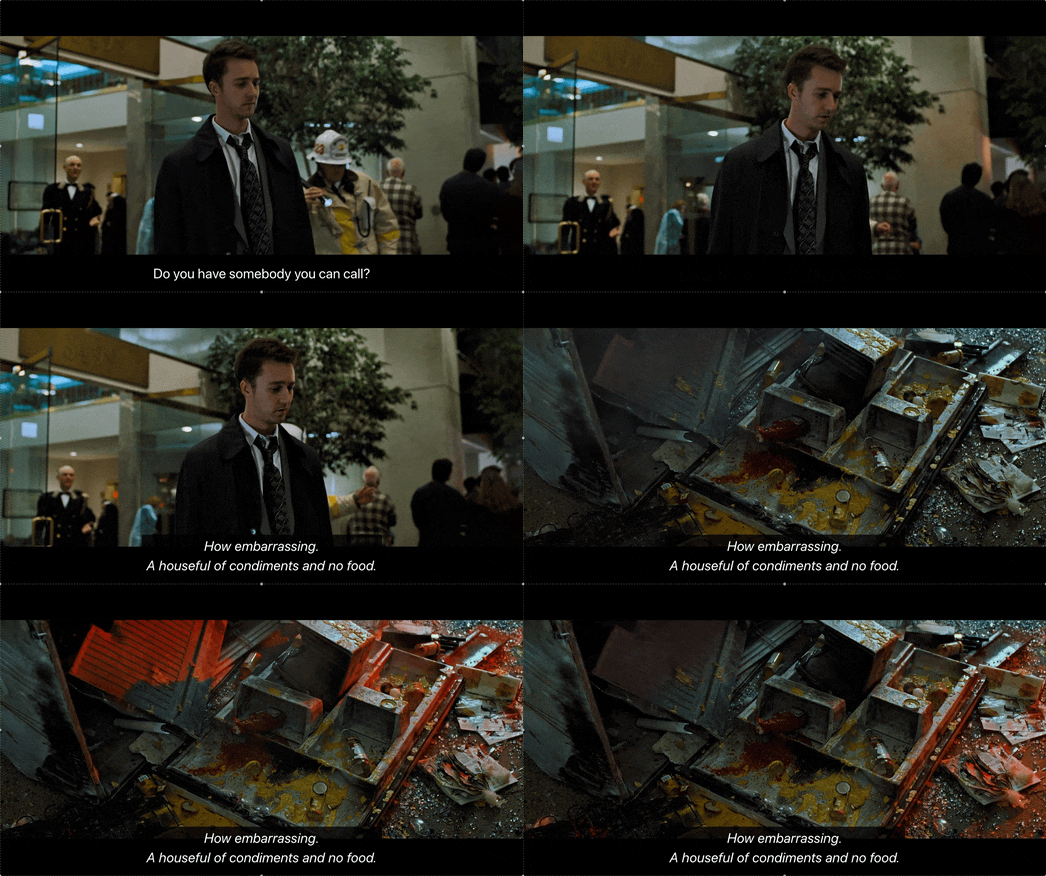
By labeling the wreckage as "embarrassing," the Narrator performs Cognitive Reappraisal. He reframes a tragedy as a social faux pas. This doesn't just describe the scene; it defines his character's defense mechanism. We learn that his identity is so tied to consumerism that he's more ashamed of his fridge's contents than he is afraid of the explosion.
So effective voiceover does one of three things:
Grants intimate access.
Creates cognitive tension through contrast.
Adds interpretive context.
Anything less is just commentary on what we already see. And that’s boring.
Psychology Cheat Sheet
What it is: Privileged Access + Cognitive Tension
What it does: Builds character-audience connection, deepens complexity, and keeps attention high by introducing new emotional or cognitive information.
Why it works (science): We’re wired to respond to privileged access — when we hear private thoughts, it activates empathy and social bonding systems. Cognitive dissonance from audio-visual mismatch prompts mental engagement as we try to resolve the contrast. And processing fluency research shows we tune out redundant input fast — but emotionally framed or surprising commentary reactivates our attention.
Effect on viewers: We feel closer to the Narrator, intrigued by the disconnect between words and actions, and pulled into the puzzle of who this character really is.
Share the article if you like it. Sharing is not boring. Trust me.
How to Write It
Ok, so we figured out what effective voiceover does: (1) grants intimate access; (2) creates cognitive tension through contrast; (3) adds interpretive context. Let’s break those down dramaturgically:
Intimate Access
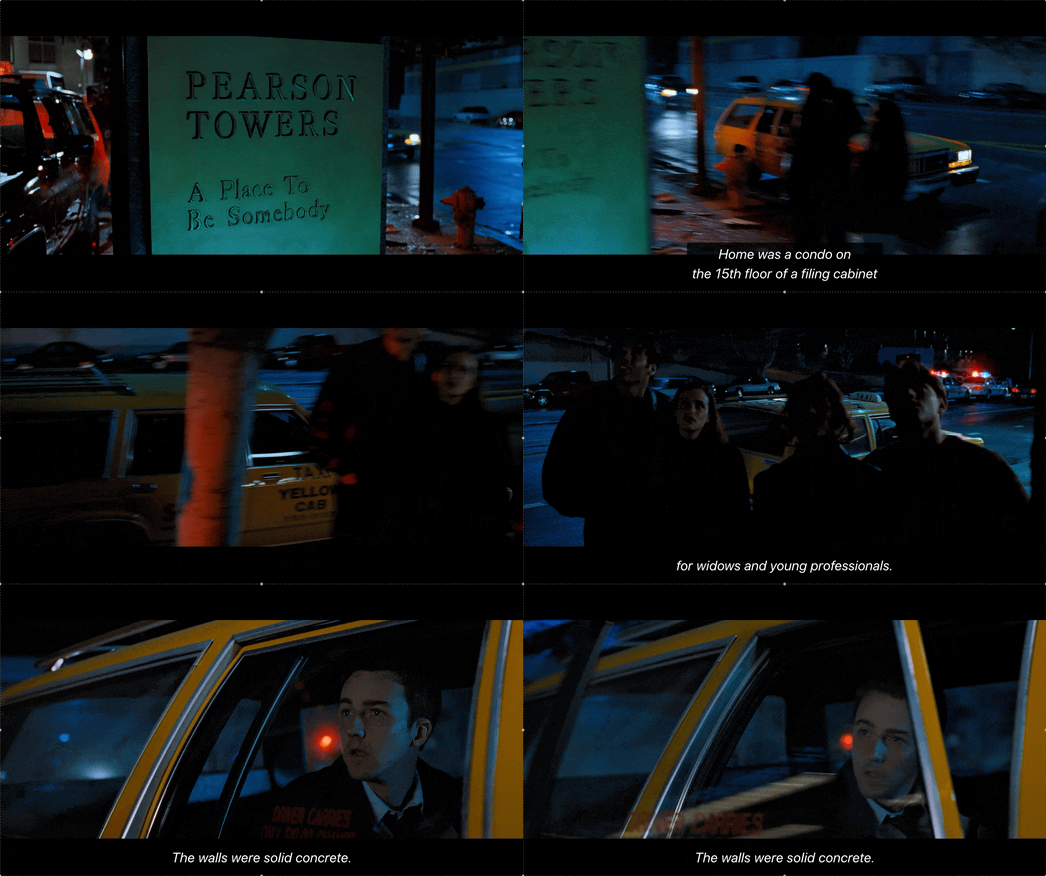
The trick is to share your character’s secrets with the audience, their inner thoughts, values, and doubts that would expand on the scene: either give us a deeper insight into the subtext, provide new information, or comment on the character’s inner state.
Imagine a breakup scene: Ann throws a plate at the wall, smashing it to pieces, screaming, “I hate you!” at her husband. The voiceover follows, “I was aiming at his head. Really. Thank God for tequila enhancing my naturally bad aim.”
We’ve just learned something the other character doesn’t know — and already feel slightly more bonded to Ann.
Cognitive Tension Through Contrast
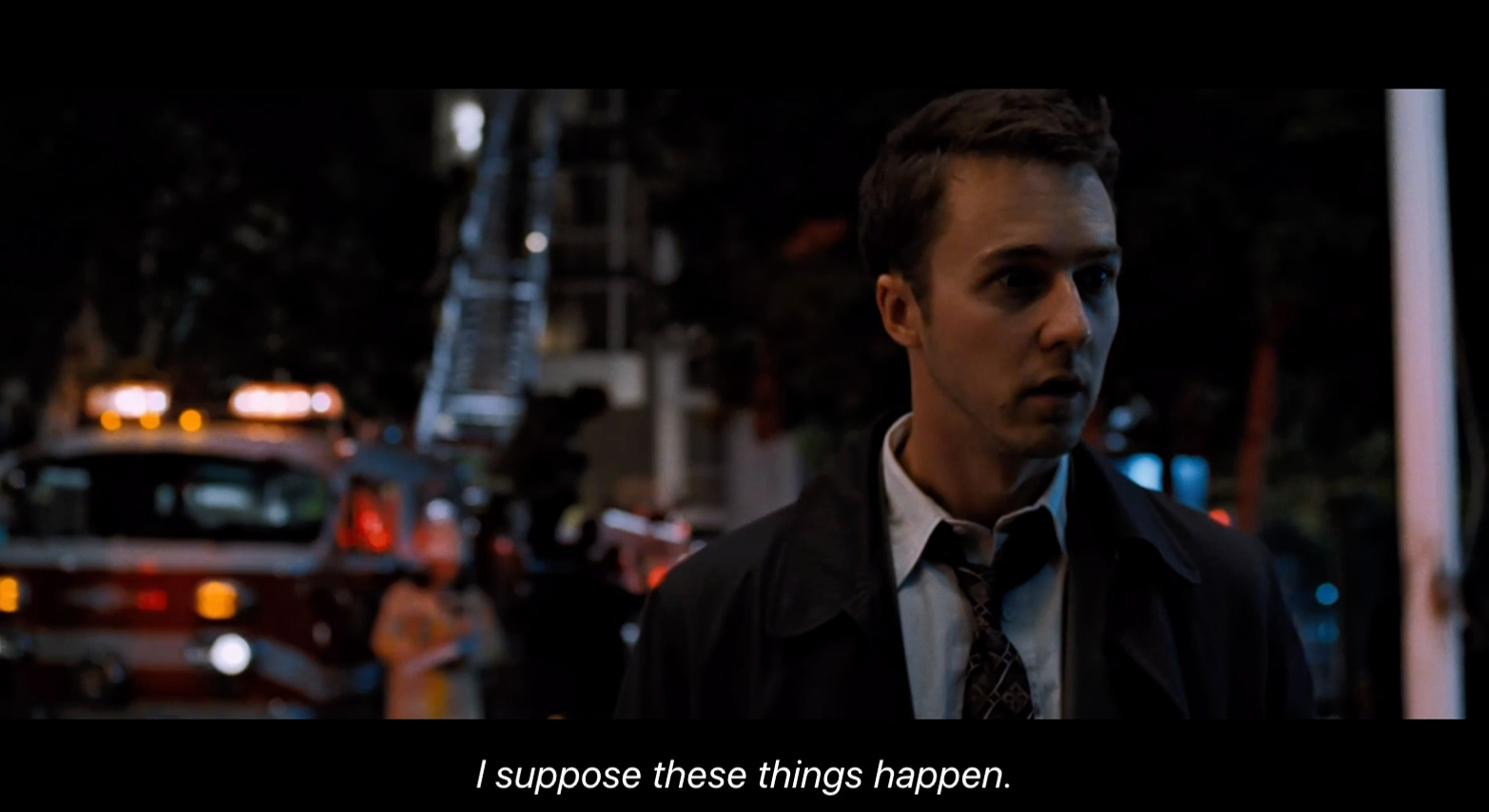
No secrets here — give us a visual and then contradict it with the voiceover to get the audience’s brains going.
Back to Ann:
Ann throws a plate at the wall, smashing it to pieces, screaming “I hate you!” at her husband. The voiceover follows “I didn’t. But he couldn’t know that”.
Oook, so does she hate him or not? And if not, what is this hysteria for? See, we’re already trying to figure it out.
Interpretive Context
Comment on what we’re seeing on screen, but add information on character’s emotional state or the character’s opinion.
Ann throws a plate at the wall, smashing it to pieces, screaming “I hate you!” at her husband. The voiceover follows “I always hated that plate.”
We’ve seen the smashing, no need to repeat that in the voiceover. What we didn’t know is that Ann hated that plate specifically.
Or if we don’t want a character insight, let’s at least add some context about the plate itself that expands the world: …The voice-over follows “That’s $300 I just smashed”.
What we don’t want to do is this:
Ann throws a plate at the wall, smashing it to pieces, screaming “I hate you!” at her husband. The voice-over follows “I kept on smashing everything I could lay my hands on”.
Duh.
Before I sign off, let’s add a bit of interactivity:
What are your favorite films with voiceover? Do you use voiceover in your own writing?
Comment below — I’m always looking at fun films to break down. And as we figured out today, voiceover is fun. And one of the easiest ways to get your audience bonded to your character, especially if your character is not particularly likable.

Until next time.