

How to Convey Complex Themes
And put the audience in your "character's shoes". Spoiler: It's not about making us care for the characters; it's the opposite. Looking at "Triangle of Sadness".

The audience must always empathize with the characters, right? To feel connected, to share the emotional journey. Nine times out of ten, it’s true.
But that one time separates good filmmakers from masters. If we look into psychology, strategically placed moments where we don’t care can affect us much more.
I can feel you furrowing your brow. To quote the film I’m looking at today:
THE DESIGNER
Can you relax your Triangle of Sadness? This, like, between your eyebrows here.
THE CASTING DIRECTOR
A little bit more... Okay. And open your mouth so you look a little bit more available.
Ok, that second line doesn’t apply to our conversation today, but Triangle of Sadness does.
But! First, please subscribe. I see a bunch of you reading without subscribing, and that’s just rude. Ok, not rude. But it’s so easy to subscribe - and there’s no spam or anything. Help me out here.
Let’s look at the scene.
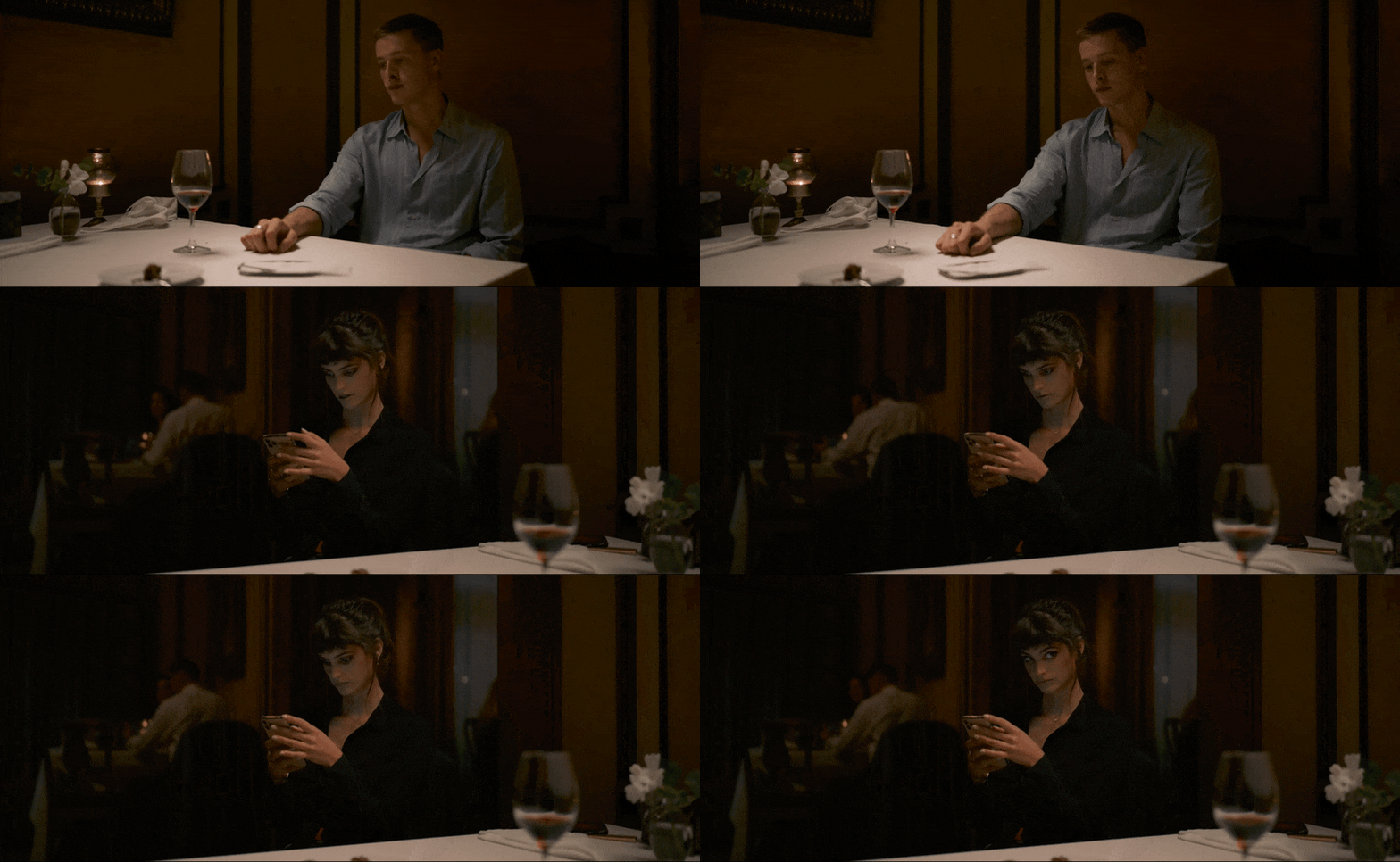
Below is the excerpt from the script itself as Ruben Östlund sets the scene.
Pay attention to how he does it, ‘cause boy-o-boy I’m about to get nerdy like you wouldn’t believe.
INT. RESTAURANT - EVENING
Later that night, Carl finds himself at an intimate restaurant with his girlfriend, Yaya. They have enjoyed a long meal together, and the night is now winding down. Only one sensitive moment is still up for this relatively new couple - the bill has to be cleared. On a first, second, third, or even a fourth date, Carl would not feel that he would have any other option than to pay up. This night, though, if Carl doesn’t want to be stuck playing the stereotypical “man”, he has to take the bull by the horns.When the waiter puts the bill on the table between them, Carl realizes that Yaya is perfectly fine with the defined roles and that she’s willing to fight…
The rest of the scene is a funny, smart, extremely relevant fight over socially conforming roles in a relationship, including:
Carl trying to play it down, Yaya turning it into a joke, Carl pressing on, Yaya lying that she hasn’t even seen the bill, Carl calling her out, Yaya making a scene, Carl feeling guilty and backing down, Yaya gaslighting him and paying.
Then, hilariously, her card doesn’t work. She tries to gather enough cash, but Carl ends up paying anyway.
It’s really not that exciting when I sum it up, but seriously, just go watch the scene and keep in mind that Ruben is bringing up a much larger point than a simple bill.
And most importantly, how this scene makes you feel, because what happens here psychologically is a Swedish chef’s kiss.
Let the nerd-fest begin! Psychology
1. Character-as-a-Vehicle
Carl and Yaya in this scene aren’t hyper-specific personalities; they’re a type we immediately recognize (young couple negotiating the bill). By keeping them slightly generic, the film turns them into vessels for us. Instead of just empathizing with their predicament, we identify – we mentally swap in ourselves. Psychologists differentiate empathy (feeling for someone) from identification (feeling as if you are them), and the latter packs a bigger punch.
The brain actually blurs the line between self and character when we identify; we start using the same neural circuits for the character that we use for thinking about ourselves. In essence, Carl becomes an avatar for the audience’s own anxieties and pride in that awkward who pays moment.
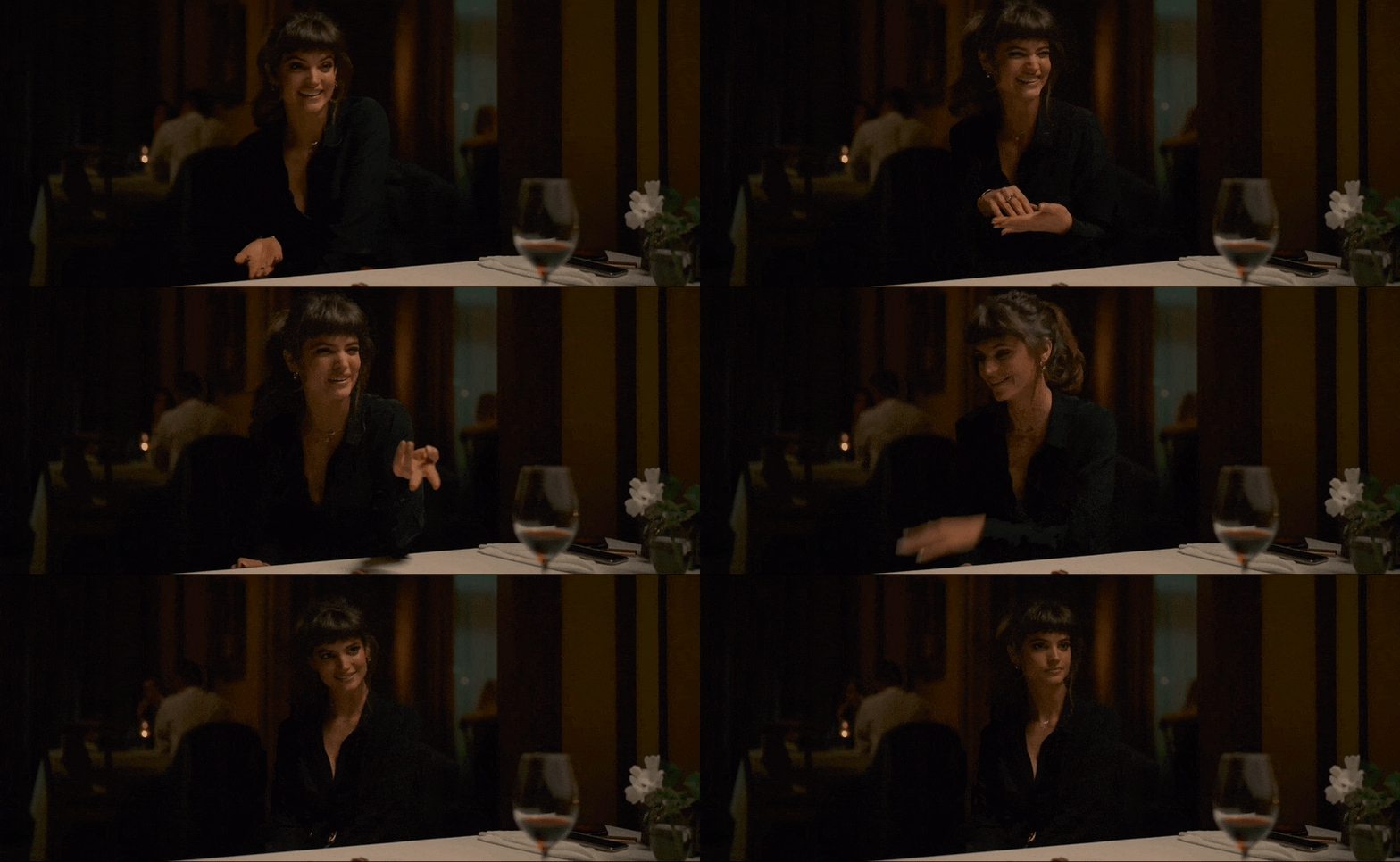
This self-projection trick draws us deeper in: we’re not watching them fight a petty bill battle – we’re fighting it in their skin. Our mirror neurons and imagination light up to “mind-meld” with Carl (or Yaya), so every spike of tension and twinge of embarrassment hits with personal force. By being broad enough to be universal, the characters invite us to fill in the blanks with our own emotional history, which makes the scene feel eerily about us and our social expectations, not just two strangers on a screen.
P.S. To clarify, Yaya is also an “avatar” (Character-as-a-Vehicle) in this scene. Since I’m more of a Carl-like type (same good-looking, obviously), the effect of identifying with him is stronger for me, but it works both ways if Yaya, as a concept, is someone you can see yourself as.
Psychology Cheat Sheet:
What it is: Character-as-Vehicle (Identification > Empathy)
What it does: Broad, recognizable types invite us to slip into their shoes, not just feel for them.
Why it works (science): Identification increases self–other overlap in the brain’s simulation/mentalizing systems, making the scene feel personally relevant.
Effect on viewers: Stakes feel mine, not theirs; tiny social slights hit like real ones.
2. Concreteness Effect
The film takes a big abstract issue – gender roles and power in relationships – and pours it into a single, mundane physical scenario: who picks up the check. This focused, concrete framing acts like a conceptual metaphor, letting us literally grasp the big idea in a tangible way.
Here, all the complex social tension around fairness and expectation is distilled into the very relatable sight of a bill on a table that neither party readily grabs. It’s simple and crystal clear – a real-world action we’ve all either experienced or can easily imagine. That physical construct gives our brains a familiar hook: we don’t have to intellectualize an academic notion of “upended gender norms,” we just watch a wallet hesitate. Emotionally, it also zeroes in on our sympathies. Anchoring a broad conflict in one pointed gesture collapses the psychological distance – suddenly the lofty idea of gender dynamics feels immediate, personal, ours.
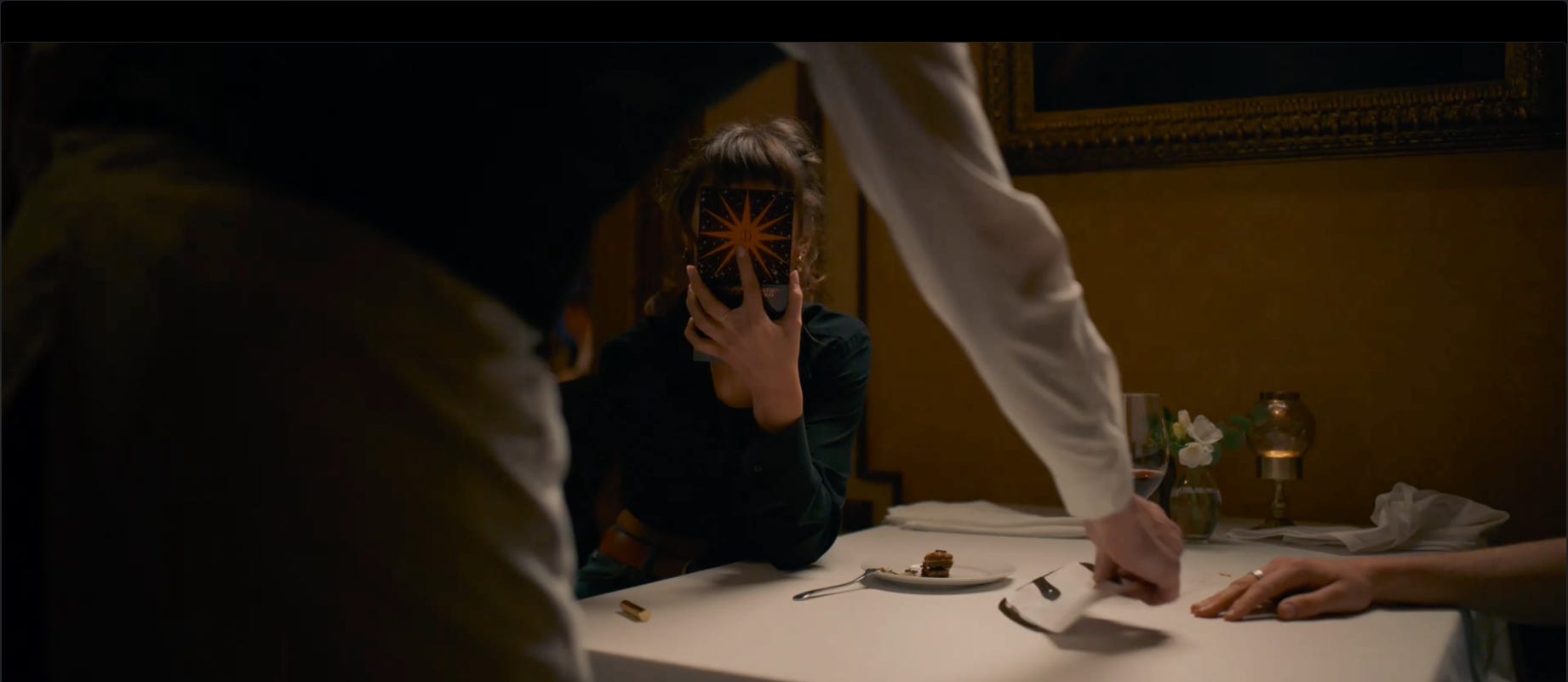
In storytelling terms, it’s efficient and potent: one small everyday conflict becomes a stand-in for an entire battle of ideals, and because it’s concrete, we absorb the underlying message without effort. We feel the concept instead of overthinking it.
Psychology Cheat Sheet:
What it is: Concreteness Effect (Big Idea → One Physical Task)
What it does: Distills “gender roles & power” into a single tangible decision: who pays.
Why it works (science): Concrete framing is processed more fluently and remembered better (dual coding, lower psychological distance). Specific, vivid cases elicit stronger emotion than abstract talk.
Effect on viewers: Concept feels clear, close, and emotionally sticky.
3. Pressure Cooker Effect
This scene is a masterclass in bottled tension. Carl is seething on the inside but, stuck in a polite social setting, he swallows his true feelings. That suppression is like a lid clamped on a boiling pot – and we sense the pressure mounting. Why is this so squirmy for viewers? For one, we’re exquisitely tuned to subtext and body language; when a character’s outward calm doesn’t match their inner turmoil, it sets off alarms in our social brains.
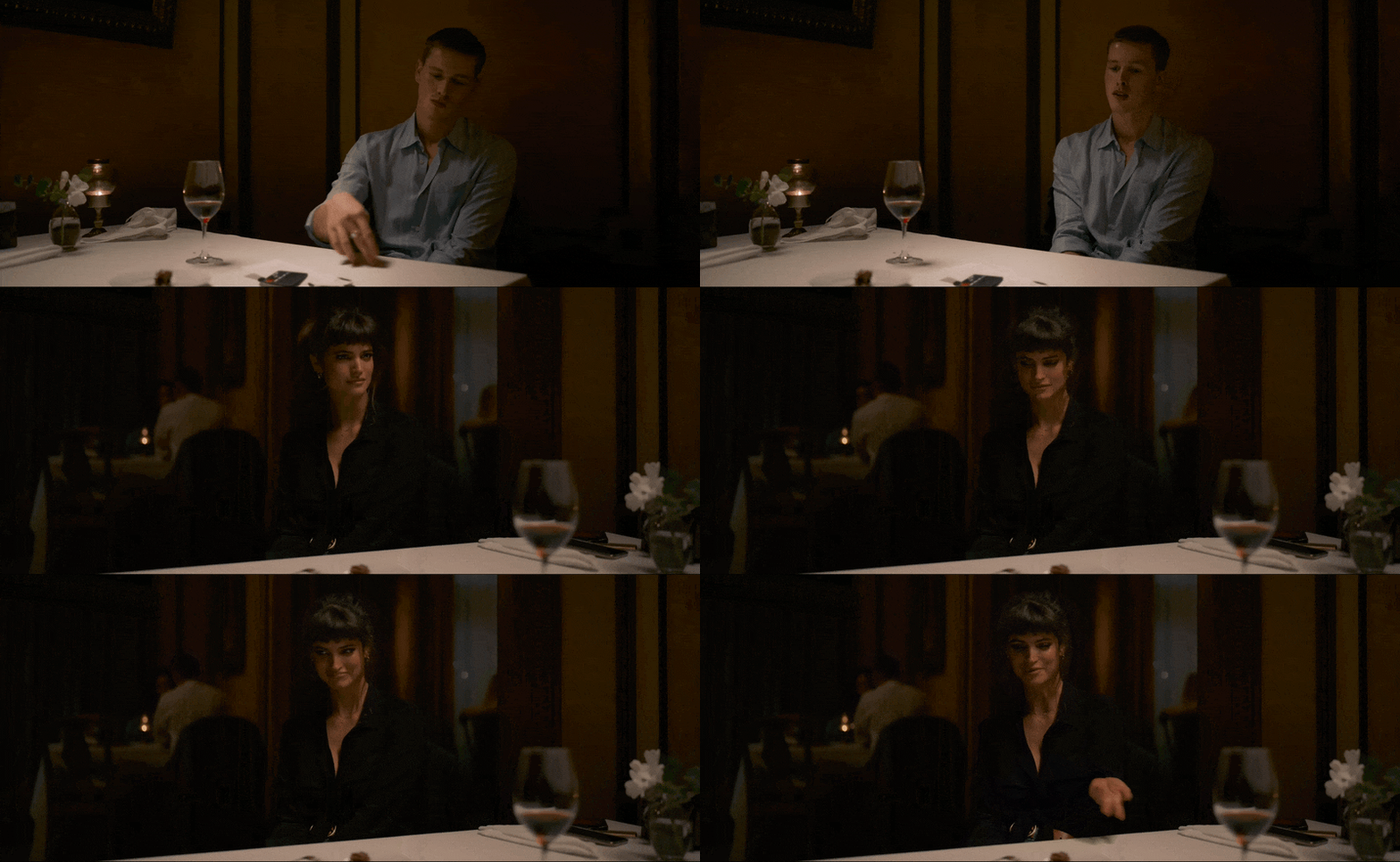
Lab studies show that expressive suppression ramps up stress responses and even elevates a partner’s blood pressure in live interactions; observers absorb the strain too (empathic stress is a real, measurable cortisol bump just from watching someone under social pressure). Add uncertainty about when the truth will spill, and arousal stays high. That’s why the scene feels like a low-voices suspense set-piece: tension accumulates until one tiny nudge can blow the lid off.
Psychology Cheat Sheet:
What it is: Pressure Cooker (Suppression → Release)
What it does: Polite public setting blocks honest expression; tension accumulates under the table.
Why it works (science): Expressive suppression raises physiological arousal; observers pick up that strain (empathic stress). Uncertainty about when it’ll blow sustains suspense.
Effect on viewers: Restless anticipation followed by a bigger, more cathartic pop when it finally breaks.
Oof, that was something. Let’s talk writing.
1. Want to get your audience into your characters’ shoes?
Keep the situation universal, specifics light but credible; cue a common dilemma (the bill) and let the audience project.
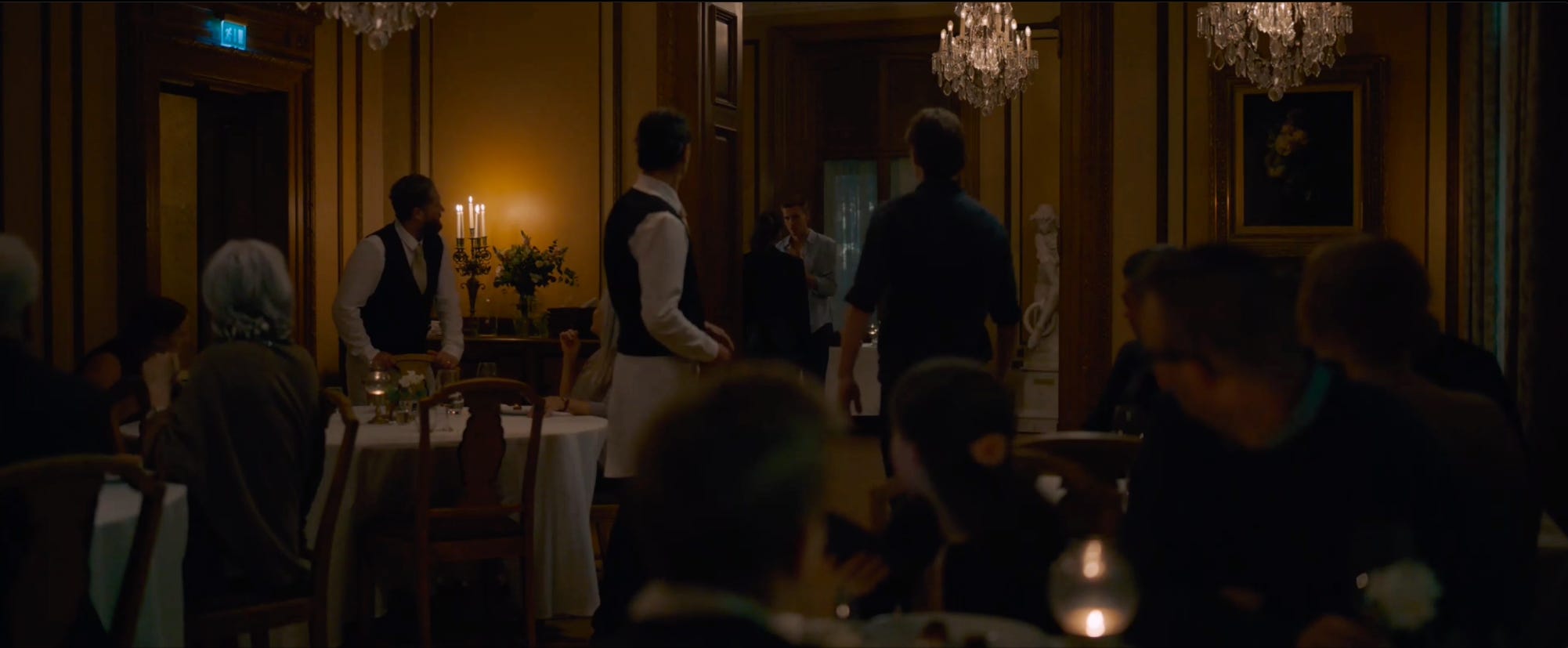
In the case of Triangle of Sadness, it breaks down to this:
A. A slightly generic location — a fancy, a bit stuffy, but really nondescript restaurant playing some faint, generic classical music. Just enough to still be believable, but allow for our minds to replace it with any other fancy place we’ve been to.
B. Giving your characters subtle caricature treatment. Prior to this scene, we’ve met Carl and Yaya very briefly. All we really know is they are models - nothing else. The way they fight in this scene is also just the right amount of generic. That conceptualization allows us to identify with their roles in this conflict and circumstance, rather than build empathy for either of them (which we will do later).
Note that outside of this scene, Carl and Yaya are super detailed and specific - not generalized at all. Character-as-a-Vehicle is a very potent device, but must be used strategically and rarely, as a major contrast to empathy-building scenes.
2. Want to get a complex theme across and still have people come to watch your movie?
Good luck getting funding.
Anchor the theme to one physical construct; minimize moving parts so attention locks onto the metaphor (the bill) and the audience can feel the thematic complexities instead of being told.

The key is to find something practical and visual that would prompt subtext and thematic elements to take central stage. Give the audience something simple to latch onto instead of feeling lost in smartly worded philosophizing: a conflict around paying a bill that stands in for a nuanced topic of gender roles, for example.
3. Want to build tension in a “simple” dialogue-driven scene?
Create circumstances forcing the characters to stay civil (status, social norms), leak micro-tells, escalate tiny violations, and delay the outburst until it has to happen.
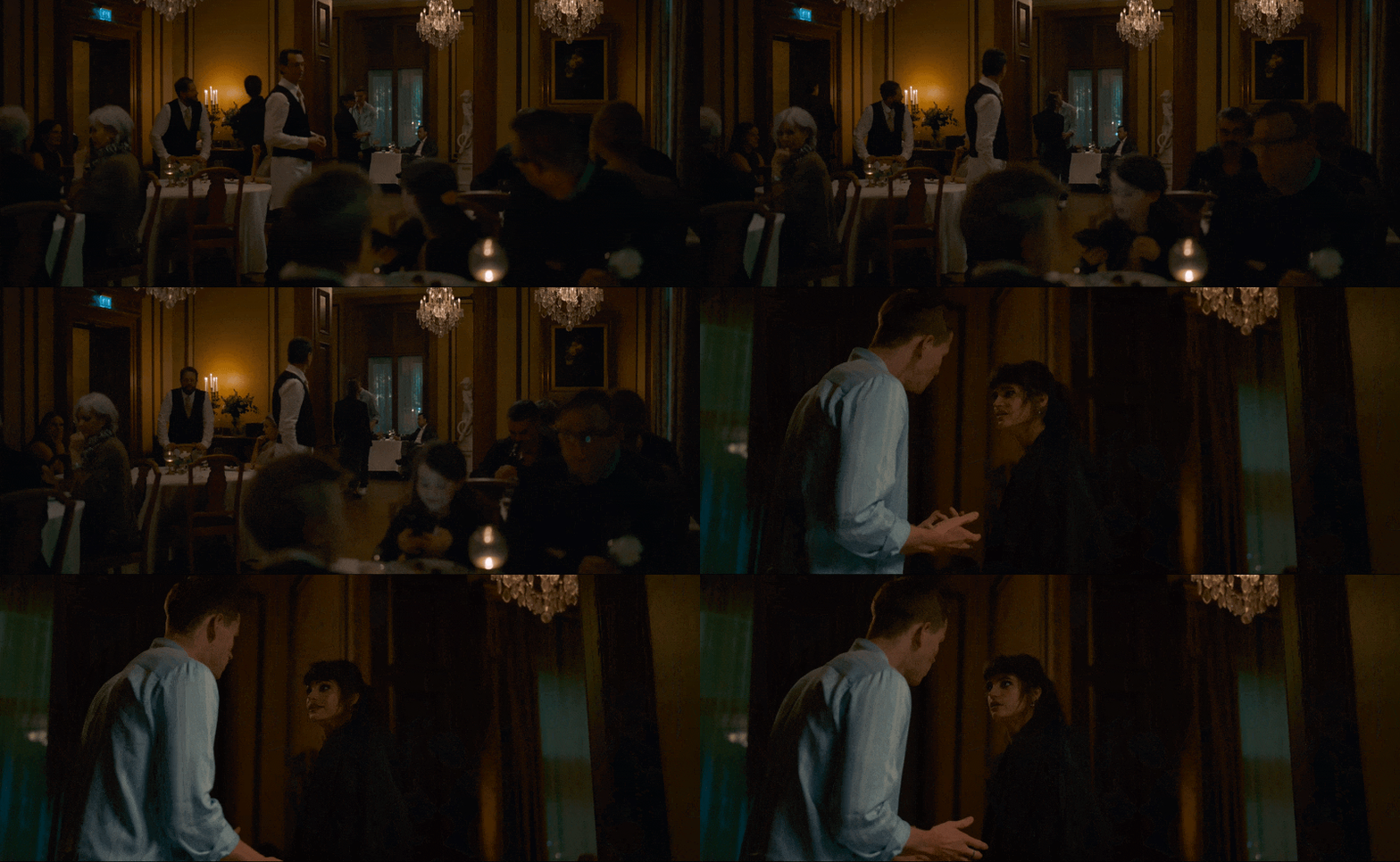
Triangle of Sadness is quite a step up in advanced dramaturgy, but if you want to be the best, you gotta learn from the best, right?
The other way to get there is “And open your mouth so you look a little bit more available”. Not judging by the way (obviously am).
Vibes can get you really far, but if you’re after a "three Michelin star” level of quality, mastering this dance of when to connect the audience with the character and when to separate is a must.
The secret sauce to it all is change. Always play with your audience, always change: rhythm, elements of tone, twist and turn, always try to catch them unawares. Luckily, there are tools.
This is the button to get more tools every week. For free. I mean, come on.
You get all this and a cat picture. NO BRAINER.
Also share. It really helps me find friends.

He must be taking his vitamins, but instead, he eats around them and then gives me this look. What are psychological tools to make your cat take vitamins, huh? Anyone? Comment below.
I’m not even joking. I actually could use advice.
See you.